Why Reforestation Matters
Trees are one of the world’s oldest and most proven technologies for healing the planet. They draw down carbon, moderate temperatures, restore watersheds, and provide habitat for countless species of plants and animals.
Reforestation 101
What is reforestation?
Reforestation is the work of bringing forest back to land that has lost its trees, whether to wildfire, pests, harvest or clearing. Trees are planted or seeded so the land can grow back into a working forest, with the soil, water and wildlife that come with it.
Forestation definition
Forestation means establishing a forest, and it covers two kinds of work. Reforestation replants land that was forest until recently. Afforestation plants trees on land that hasn’t been forest for a long time, or ever. BGPP funds reforestation: native species going back onto burned boreal land in Canada.
Tree superpowers
Why is forestation important?
Old technology, still the best in class. Each tree is a tiny machine doing four big jobs at once — and the bigger our forests grow, the more powerful the system becomes.
Drawing down carbon
Pulls CO₂ from the air and locks it into roots, trunks and soil for decades — climate work that compounds quietly, year after year.
Moderating temperatures
Shade, transpiration and canopy cover cool the air around us — from streets and farms to the watersheds those forests sit in.
Restoring watersheds
Roots hold soil, filter rain, and slow runoff. Forests are how clean water shows up downstream — for people, fish and farms alike.
Habitat for everything
Birds, fungi, pollinators, mammals, lichens — a thriving forest is a city. Plant the trees and the rest comes back to live in them.
forests under pressure
Wildfires and pests are eroding our forests faster than they can recover.
The threat. Wildfires and pests are stripping carbon, habitat and watersheds — at a pace nature alone can't keep up with.
The work. Right tree, right place, right reason — and a forest that's tougher next time the wildfires roll through.
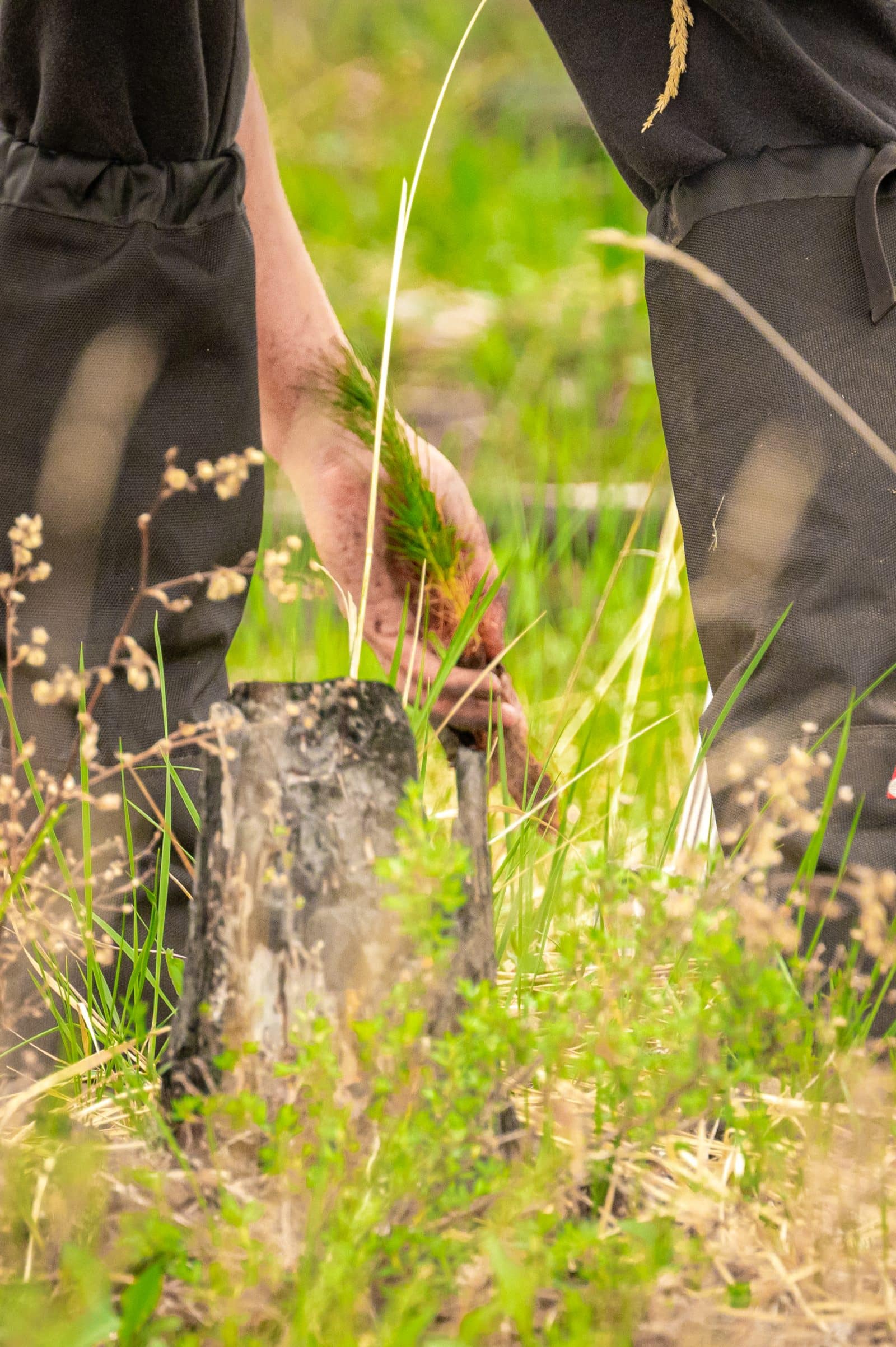
Trees go in the ground at Devil’s Lake Kistike’win.
The Blue Green Planet Project funds reforestation in Canada — currently at Devil’s Lake Kistike’win in central Manitoba, an Indigenous-led wildfire restoration project bringing native jack pine back to land outside any Forest Management Area. Five seasons in, 5.9 million trees in the ground, with 3 million more going in the 2026 season.
By funding tree planting, BGPP’s partners help close the gap on land that wouldn’t be planted otherwise — and they make climate action a tangible, documented thing rather than an abstract commitment.
Why the Boreal?
The boreal holds a major share of the world’s intact forest, along with significant carbon stored in northern soils and tree biomass. It is also facing growing wildfire pressure, with fires burning hotter, happening more often, and returning before forests can recover naturally. Restoration on burned boreal land is not just about replacing what was there. It gives the forest a viable head start in a climate where natural regeneration is no longer guaranteed. That is the work at Devil’s Lake Kistike’win, and the work BGPP funds on land that might otherwise remain barren.
Funding trees through BGPP makes you part of something growing.
You’re joining brands, communities, and individuals who are restoring our forests — for today and for the generations that come after.